Glacier Modeling to Guide Investment on the Bradley Lake Hydropower Project
Determining the lifespan of new energy investments.
Note: Case studies shown are a combination of Northern Analysis engagements and professional projects from our founding team’s careers. No confidential, proprietary, or sensitive information is disclosed. Certain details may be generalized or omitted to protect client, employer, and stakeholder confidentiality.
Summary
Bradley Lake, Alaska’s largest hydropower facility, is being expanded to help close an incoming energy shortage along the Railbelt. Dixon Glacier on the Kenai Peninsula is a leading candidate to feed a proposed 60-megawatt addition to the system. The investment only makes sense if the glacier produces enough meltwater, for enough time, to justify the infrastructure.
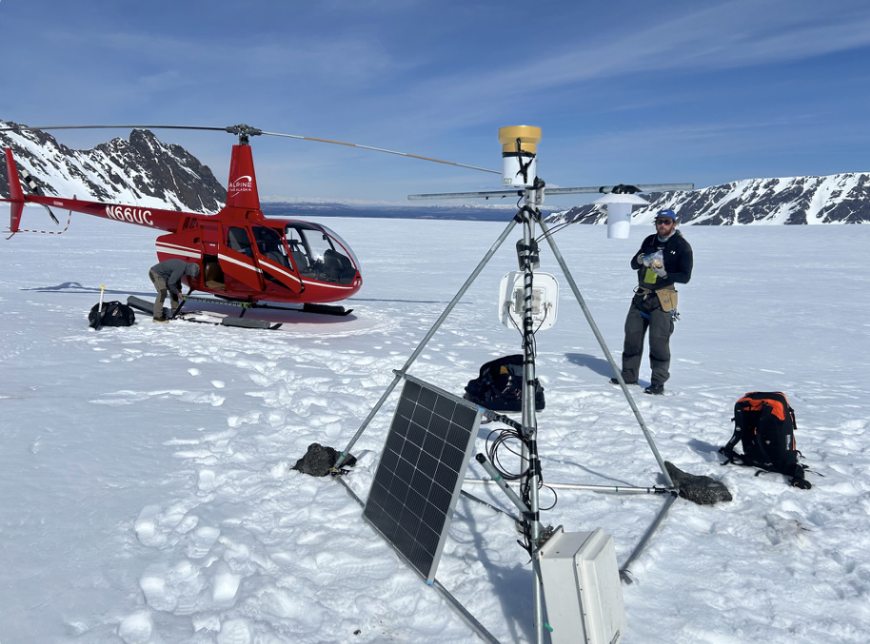
Kai built a glacier melt model for the Dixon Glacier by studying the glacier in the field over a period of three years. The model was calibrated against field measurements, satellite data, and a 35-year climate record. Water availability was projected through 2100 across various climate scenarios. The modeling produced projections on how long the resource will last, and the projected flow rates for each year. It confirmed that the glacier will generate viable flow for the project until at least 2100, under various climate scenarios.
Situation
The Railbelt energy grid is in critical need of expansion due to an impending natural gas shortage. A key candidate for expansion was the Bradley Lake hydropower facility, with nearby glacier meltwater streams the facility could merge with.
A 60-megawatt diversion was being proposed to capture the flow from the Dixon Glacier, but the viability of the glacier needed to be studied to determine the project’s economics. Global warming was a key concern. With glaciers rapidly shrinking, it was unknown how long the hydropower resource would last. With the cost of the expansion at nearly $500 million, it was crucial to determine if the project would produce enough electricity to justify the investment.
Solution
Kai built a glacier-specific water yield model for Dixon Glacier. The model drew three years of field measurements collected at multiple elevations on the glacier, satellite-derived data tracking glacier area and ice loss back to 2000, and a 35-year climate record from a nearby monitoring station. This was used to develop a probabilistic model, which reflected the range of scenarios within the uncertainty band of global emissions and the glacier’s physics.
The calibrated model was run through a scenario ensemble — three emissions pathways, five global climate models, and hundreds of parameter combinations. This produced projections of glacier area, ice volume, and annual water discharge from 1999 through 2100. Confirming the output to independent USGS benchmark data and projections from the Wolverine Glacier verified the accuracy of the model.
Results
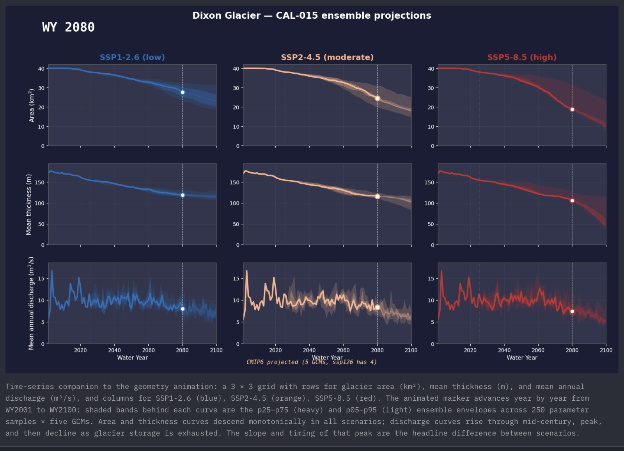
The model provided water flow projections for the next 75 years, across a range of emissions scenarios. This confirmed that the resource would last to at least 2100, and forecasted the lifespan and electric output of the project, allowing the economics to be directly evaluated against other potential energy investments.
Under aggressive warming, water flow significantly increases mid-century, but reduces sharply towards 2100, with the glacier losing 85% of its volume. Under low global warming, the water flow still peaks mid-century and declines at the end, but less drastically, with project lifespan extended. In either range of scenarios, the glacier is confirmed to provide a reliable hydropower resource until at least 2100.