Forecasting Alaska’s Finances Under Alternative Fiscal Regimes
Scenario planning to guide a state fiscal plan.
Note: Case studies shown are a combination of Northern Analysis engagements and professional projects from our founding team’s careers. No confidential, proprietary, or sensitive information is disclosed. Certain details may be generalized or omitted to protect client, employer, and stakeholder confidentiality.
Northern Analysis LLC is an independent company and is not affiliated with any government entity. The firm does not accept engagements that create, or could reasonably appear to create, a conflict of interest with any team member’s public position or official responsibilities.
Summary
Alaska’s revenue streams are among the most volatile in the country, swinging sharply with global oil prices. Developing a fiscal plan to stabilize revenue, support the Permanent Fund, and improve budgetary planning has been a recurring statewide effort. When the administration prioritized developing a comprehensive fiscal plan in late 2025, the Department of Revenue’s existing modeling tools were not efficient enough to support the speed or analytical depth required. At the Department of Revenue, Arnav redeveloped and redesigned the state’s fiscal planning model from the ground up. He expanded scenario analysis to a broad range of policy levers, and led quantitative scenario analysis with the Office of Management and Budget. The solution reduced scenario forecasting time by several days per scenario, and allowed the effects of a broad range of fiscal strategies, including highly detailed multi-variable strategies, to be rapidly projected across the state’s revenue, spending, Permanent Fund, PFD, and savings accounts over the next 15 years. This model became the quantitative foundation for SB 227, the comprehensive fiscal plan introduced to the Legislature in 2026.
Situation
The State of Alaska has a complex fiscal environment. Oil revenues, Permanent Fund drawdowns, dividend obligations, and spending interact in ways that make simple projections unreliable for policy. Developing a comprehensive fiscal plan required modeling how policy choices translate quantitatively across all these factors, across existing and alternate revenue sources, spending paths, dividend formulas, and savings reserves.
The scale of the proposed fiscal strategies was beyond the capabilities of the Department’s existing modeling. Running a new scenario was slow, resource-intensive, and prone to inconsistency when variables changed mid-analysis. With legislative deadlines driving the timeline, the team needed to evaluate a large number of policy combinations quickly and reliably.
Solution
Arnav redesigned and reconstructed the fiscal planning model to support faster, more flexible, and more reliable scenario analysis. The redesigned model allowed analysts to have fine control over nearly any fiscal or policy variable, allowing for better simulation of the combined impacts of alternate revenue sources, spending paths, fund transfers, Permanent Fund rules, dividend policies, and savings strategies.
The development required a restructuring of the backend data structure and a new program control dashboard. He also devised a new policy and scenario implementation method that natively incorporated Alaska’s fiscal complexities, especially around the interaction of oil price scenarios, revenue policies, and Permanent Fund decisions. This allowed scenarios and policy levers around those variables to be natively incorporated within the model’s calculation workflow, instead of as ad-hoc manual adjustments. This was a key component in ensuring model accuracy and removing resource-intensive manual processes, saving several days of modeling time per fiscal scenario.
Concurrent to model design, he led quantitative scenario analysis of fiscal strategies on behalf of the Department with the Office of Management and Budget, verifying proposed strategies and translating results into formats usable by executive and legislative staff.
Results
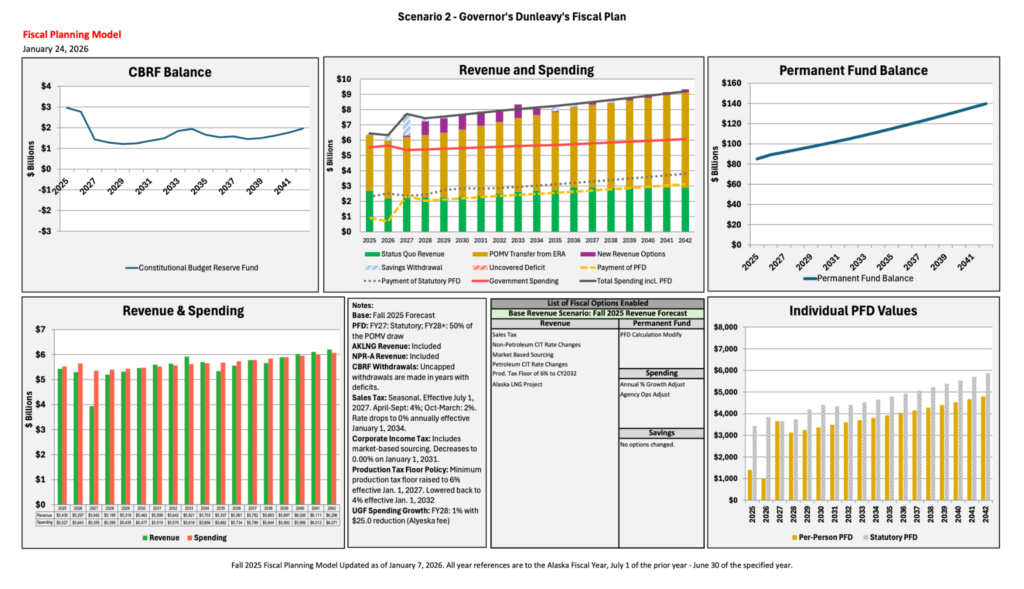
The model’s projections formed the quantitative foundation for SB 227, the legislation introduced to the Alaska Legislature in 2026. The legislation represented the Administration’s comprehensive fiscal plan — a multi-variable policy proposal covering revenues, spending, the Permanent Fund, dividends, and reserves over a 15-year window.
Beyond the legislation itself, the rebuilt model gave the state a durable analytical asset. The system natively incorporates Alaska’s complex fiscal environment and can project the effect of fiscal proposals and policy choices across the state’s financial structure. Future fiscal proposals can now be evaluated with greater precision, speed, and consistency, rather than requiring significant manual reconstruction each time the policy landscape shifts.